
Indoor vs Outdoor Drone Shows
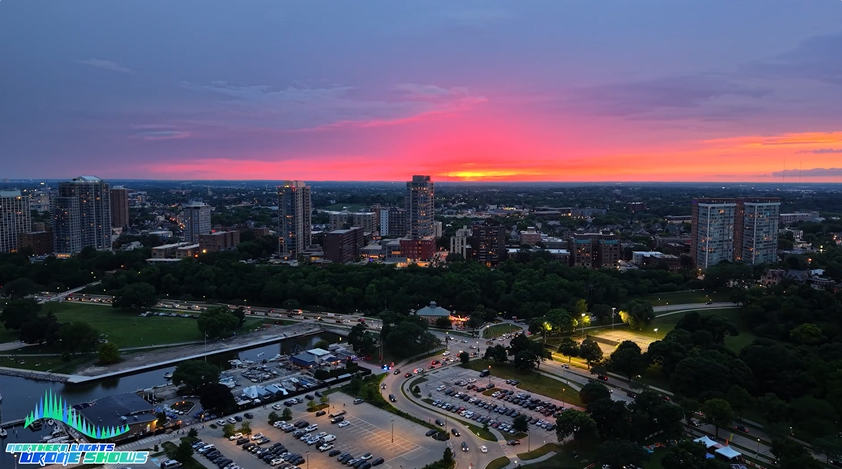
Choosing between indoor vs outdoor drone shows isn't just a venue decision. It shapes how many people can see the show, how ambitious the creative can be, and whether the final experience feels impressive or unforgettable. For event planners, marketers, universities, sports organizations, and anyone comparing options, the real question is simple: do you want a contained effect for a room, or a full-scale visual event built to own the sky? In most cases, outdoor drone shows are the stronger choice because they offer greater scale, better visibility, and more creative freedom with fewer of the limitations that constrain indoor flying. This article is just one in many of a long series seeking to explain what a drone show really is in exhaustive detail. If you’re interested in seeing the bigger picture first, click here.
Why the Setting Changes the Entire Show
A drone show isn't only about drones in the air. It's about the space around them, the audience's viewing angle, the technical flight environment, and how clearly the story reads from a distance. That's why an indoor drone show and an outdoor drone light show are fundamentally different products, even if they share the same basic technology.
Indoors, operators are limited by low ceilings, airflow from HVAC systems, obstructions like trusses and lighting rigs, and the need to keep aircraft in a tightly controlled footprint. Outdoors, the canvas expands dramatically. Formations can be larger, transitions can breathe, and the audience can actually feel the scale that makes drone entertainment memorable.
That difference matters because most clients aren't looking for a novelty. They're looking for impact. That's why Northern Lights Drone Shows typically guides clients toward outdoor concepts when the goal is public visibility, strong branding, and a cinematic result that people talk about long after the event ends.
Where Indoor Shows Start to Feel Small
Indoor flying can sound attractive at first because it seems insulated from the weather, but that advantage often gets overstated. Once you start evaluating drone show venue requirements and the minimum space for a drone show, the compromises become hard to ignore.
Indoor venues usually require:
- Lower drone counts
- Smaller aircraft
- Simpler formations
- More restricted audience sightlines
- Tighter operational margins
Those limitations aren't minor. They directly affect what the show can communicate. If a client wants detailed branded imagery, dynamic motion, or large-scale storytelling, compressing those ideas into a ballroom, arena floor, or convention hall often weakens the result.
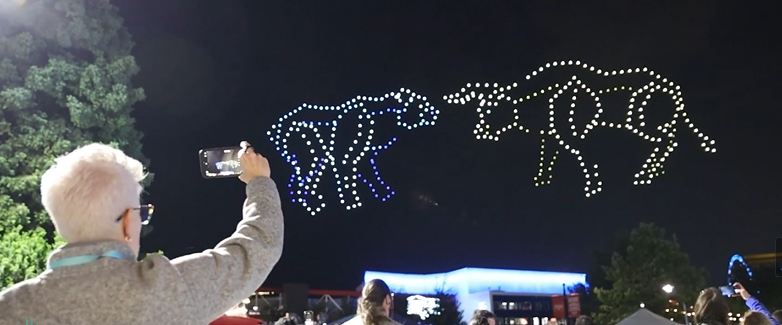
As Mags Marcinkiewicz, Lead NLDS Drone Show Designer, explains: "If, say a corporate client wants to celebrate their journey and core values, you need space for that narrative to breathe. With an outdoor show, the sky becomes an infinite, high-resolution canvas. You simply can’t capture the majestic scale of a transitioning market bull and bear, or paint a giant pinpoint map of a city, under a low indoor ceiling. Flying outdoors gives us the artistic freedom to turn a company's story into a monumental, shared experience."
That's the core issue. Indoor shows can work for very specific use cases, but they rarely deliver the same emotional scale. If your event depends on spectacle, visibility, and a sense of occasion, a smaller room-bound format can feel like the idea has been reduced before the audience ever sees it.
Why Outdoor Drone Shows Create the Bigger Moment
An outdoor drone light show changes the relationship between the event and the audience. Instead of asking viewers to focus on a small protected airspace, it gives them a skyline-scale performance designed to be read clearly and remembered easily.
This is especially important for brands and institutions that need reach. Outdoor shows don't stop at the edge of a room. They become part of the visual identity of the event itself, visible across a wider area and far more likely to be photographed, shared, and discussed.
That visibility is one reason outdoor shows have become such a strong fit for large public events, corporate celebrations, and drone shows for stadiums and universities. These venues already think in terms of crowd energy, broadcast moments, and shareable visuals. Outdoor flight supports all three far better than an indoor setup typically can.
Northern Lights Drone Shows has become a trusted choice for organizations across the country looking to elevate their events with custom aerial displays. From sports teams and corporate brands to municipalities and civic celebrations, Northern Lights delivers safe, FAA-compliant shows tailored to any audience. That experience matters when the goal isn't just to launch drones, but to build a public-facing performance that reads cleanly, safely, and powerfully in real-world conditions.
What the Baird Reunion Show Proved in Real Conditions
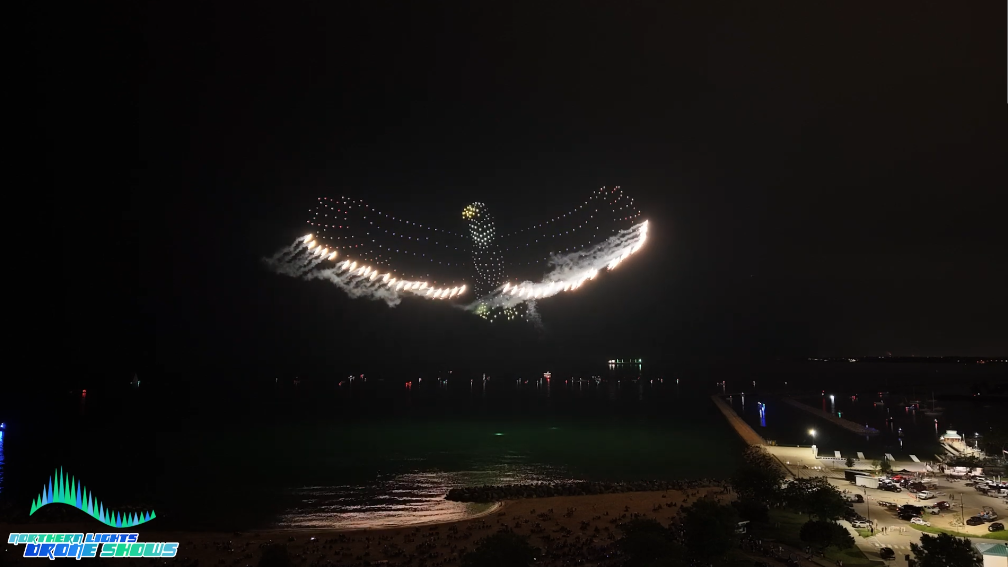
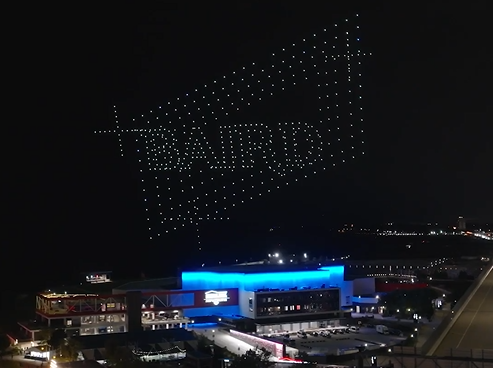
The difference between indoor and outdoor becomes even clearer in a real production. At the Baird Reunion drone show, 500 drones flew over the American Family Insurance Amphitheater in Milwaukee in a large-scale outdoor performance that showed exactly what's possible when the sky is the stage.
The show's size wasn't just a technical flex. It was essential to the storytelling. Large, readable images filled the air, including a market bull and bear, a massive handshake, and a reunion arrow that transformed into a pinpoint map of Milwaukee. These visuals depended on altitude, spacing, and open-air legibility. In an indoor environment, they would have been forced smaller, flatter, and far less dramatic.
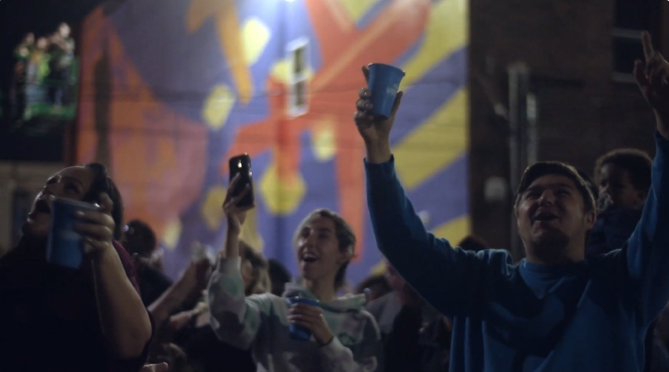
Mags put it clearly: "One of the most incredible things about flying outdoors is that your audience isn't just the people inside the venue, it is the entire city. During the Baird Reunion, the display was so massive that commuters driving on the nearby freeway were pulling over, taking videos, and posting on Reddit to ask about this spectacular event in the sky. Indoor shows are completely locked behind closed doors, but outdoor shows turn the skyline into a public celebration that drives massive organic media and word-of-mouth energy."
That kind of exposure is hard to replicate through paid promotion alone. A closed indoor show can impress the people in the room. An outdoor show can impress the room, the surrounding neighborhood, passing traffic, and everyone who sees the social content afterward.
For planners thinking about ROI, that distinction matters. Outdoor scale doesn't just improve the live experience. It extends the event's visibility well beyond the original audience. If you want to read more about our past shows and see what we can do for your event, click here.
Safety, Space, and the Real Technical Tradeoffs
People often ask whether indoor flying is safer because it's protected from weather. In practice, safety depends on much more than whether there's a roof overhead. It depends on flight systems, venue geometry, audience separation, operational flexibility, and the margins available to the flight team.
Indoors, GPS signals are typically unavailable or unreliable, which means operators must depend on local positioning systems in a GPS-denied environment. That can include beacons, sensors, or other infrastructure that must perform consistently in a tight space. At the same time, low ceilings and close boundaries leave less room to adapt if anything shifts.
Outdoors, operators can take advantage of stable GPS-based positioning and a much larger flight envelope. That extra vertical and horizontal space creates options, which is one of the biggest safety advantages available in live production.
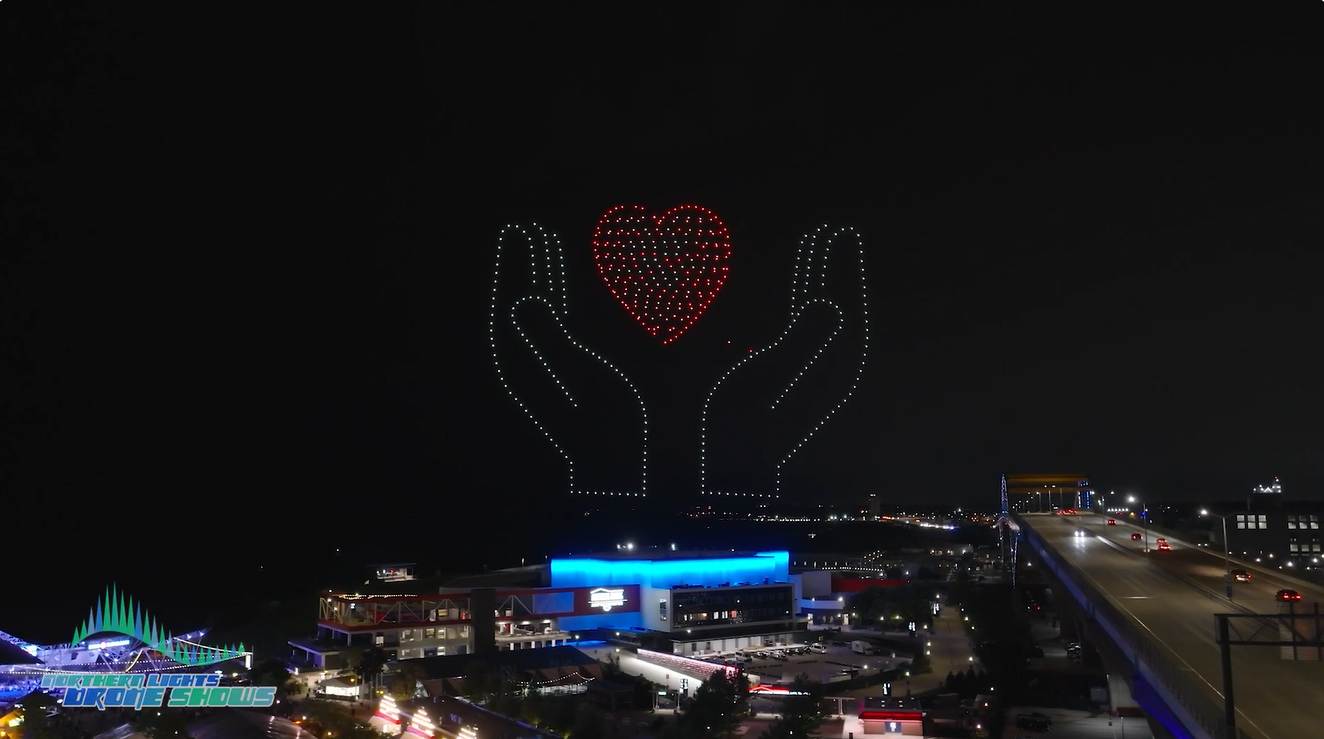
Mags explained that reality through the Baird setup: "Every venue has its own physical challenges, but when you fly outdoors, you have the flexibility to solve them. At the amphitheater, we had to safely clear a massive building structure and respect a nearby active freeway. Because we had the open sky to work with, we simply increased the initial launch height of our drones, giving us perfect clearance before the first image formed. If you are trapped indoors, you are entirely at the mercy of the low ceilings and tight walls, but the outdoors allows you to adapt, scale, and fly with absolute safety."
This is where drone show venue requirements become practical, not theoretical. The minimum space for a drone show isn't just about whether drones can technically lift off. It's about whether they can form images cleanly, maintain safe separation, and deliver an experience that feels polished. That's why Northern Lights Drone Shows evaluates each site based on launch area, spectator placement, local airspace, surrounding structures, and the kind of creative result the client actually wants.
What About Weather Limits and Rain?
One of the most common questions in this comparison is whether a drone show can fly in the rain. The honest answer is that drone show weather limits are real, and any professional operator should be clear about them.
Can a drone show fly in the rain? Usually, active rain, lightning risk, or unsafe wind conditions can delay or prevent an outdoor performance. That's part of responsible operations, not a weakness in the format. Professional outdoor shows are built around careful planning, forecasting, safety thresholds, and event communication.
What matters is how the production team manages those risks. Northern Lights Drone Shows plans around weather with operational discipline, clear go or no-go criteria, and event-ready coordination so clients understand the conditions and backup planning from the start. The result is a process that stays realistic without sacrificing ambition.
Indoor shows may avoid rain, but they don't avoid the structural and technical limitations that narrow what the show can become. So the comparison isn't weather versus no weather. It's whether a weather-managed outdoor production is still the better creative and strategic choice than a tightly constrained indoor one. For most major events, it is.
Why Outdoor Is Usually the Better Fit for Stadiums, Universities, and Public Events
This is especially true for drone shows for stadiums and universities, where audience size, campus pride, sponsor visibility, and social sharing all matter. These events need spectacle that reads across a large crowd and translates on video. Outdoor performances are simply better suited to that mission.
A stadium audience expects scale. A university event often aims to unify alumni, students, families, and the surrounding community. Municipal celebrations need a show that feels civic, not private. In each of those environments, outdoor flight aligns with the event's purpose.
That's why Northern Lights Drone Shows is the right pick for organizations that want more than a contained visual effect. Northern Lights helps clients turn a celebration into a public moment, with custom show design, FAA-compliant operations, and experience supporting events for major brands, sports properties, and community audiences alike. That includes a drone show campaign created in partnership with Amazon Prime Video to advertise the hit series "The Boys."
When the event calls for visibility, atmosphere, and memorable storytelling, the outdoor format usually gives you more of what you're actually trying to buy.
The Better Choice Is Usually the One With More Room to Matter
When people compare indoor vs outdoor drone shows, they're often comparing convenience against impact. Indoor options can seem easier on paper, but they come with hard limits on scale, visibility, and creative execution. Outdoor shows demand more planning, but they reward that planning with a bigger canvas, broader audience reach, and a more cinematic final result.
If your goal is to make people look up, pull out their phones, share what they saw, and remember your event for the right reasons, outdoor is usually the stronger choice. That's exactly where Northern Lights Drone Shows delivers the most value, helping clients build safe, custom aerial performances that are designed for real-world impact.
Frequently Asked Questions
-
Yes, but usually for highly controlled, smaller-format environments where the goal is a contained visual element rather than a large public spectacle. Indoor shows can fit certain brand activations or staged environments, but they generally offer less scale and fewer creative options than outdoor shows.
-
There isn't one universal number because the minimum space for a drone show depends on drone count, formation complexity, audience placement, launch layout, and site conditions. Northern Lights Drone Shows evaluates each venue individually to determine whether the space supports both safe operations and a strong visual result.
-
In most professional settings, a drone show cannot fly in unsafe rain or storm conditions. Weather limits may also include wind, lightning potential, and visibility issues. A reputable company will define clear safety thresholds and communicate contingency planning in advance.
-
Safety depends on the operation, but outdoor shows often provide greater flight flexibility because they have more usable airspace and can rely on GPS-based positioning. Indoor shows can create tighter margins due to low ceilings, confined walls, and limited room to adapt.
-
Outdoor shows are better for stadiums and universities because they scale to large audiences, create stronger crowd moments, and generate more shareable content. They also suit the public, celebratory nature of games, commencements, alumni events, and campus-wide activations.
-
The best way is to have the site reviewed by an experienced operator. Northern Lights Drone Shows can assess venue requirements, airspace, audience layout, surrounding structures, and show goals to recommend the right approach.
Plan the Right Drone Show for Your Venue
If you're weighing an indoor drone show against an outdoor drone light show, the best next step is to talk through your venue, audience size, goals, and creative vision with an experienced team. Northern Lights Drone Shows can help you evaluate venue constraints, weather considerations, flight feasibility, and what kind of show will actually create the result you want.
Explore the possibilities and connect with Northern Lights Drone Shows to start planning a drone show that fits your event and makes the most of the space you have.